
A nearby temperate Neptune-size planet
Published evidence
Combined transit photometry constrains the size and period. Planet Finder Spectrograph velocities support a mass near 15.4 Earth masses.
How to read the 3D model
Published periods and available eccentricities drive the orbits. Missing eccentricities are modeled as circular. Starting phases, viewing orientation, compressed distances, and surface appearances are illustrative. The atlas lists these open questions: The visible color, weather, and atmospheric composition in the selected evidence.
Planet measurements
These values use the Exoplanet Atlas’s selected published solution. A dash means the value is absent from that solution.
| Planet | Period (days) | Orbit (AU) | Eccentricity | Radius (R⊕) | Mass (M⊕) |
|---|---|---|---|---|---|
| TOI-1231 b | 24.2456 | 0.1288 | 0.087 | 3.65 | 15.4 |
TESS observations
The discovery team identified the planet as a spectroscopy target. The discovery result itself provides bulk properties.
Explore the MAST TESS archive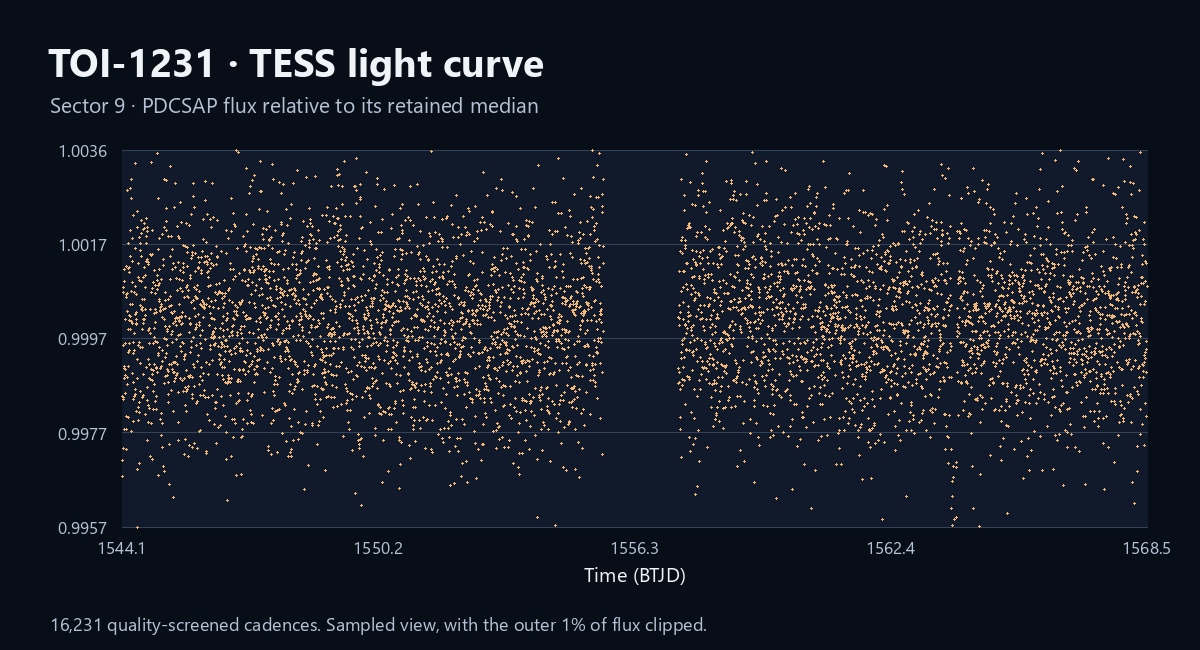
Sources
System cover illustration and observation plot from the Exoplanet Atlas.