
Spacelia

Sculptor · 204.5 light-years away

TOI-178

Six planets circle a cool orange star. The five outer worlds follow a repeating orbital pattern, even though their densities vary sharply.

Start the fly-through

Scroll to fly. Drag the scene to change your view.

Host star · late K dwarf

TOI-178

The host is smaller and cooler than the Sun. Its estimated temperature guides the model’s amber color and the light on the planets.

Temperature
4,316 K
Radius
0.662 R☉
Mass
0.647 M☉

TESS identifier TIC 251848941. Stellar surface detail is illustrative.

Innermost planet

TOI-178 b

The innermost and smallest known planet circles the star in under two days. It sits outside the five-planet resonant chain.

Period
1.91 days
Radius
1.2 R⊕
Mass est.
0.96 M⊕
Orbit
0.02607 AU

Surface and atmospheric appearance are illustrative.

Resonant chain member

TOI-178 c

The resonant chain starts here. The catalog mass estimate is higher than for the innermost planet, and its measured radius is larger.

Period
3.24 days
Radius
1.754 R⊕
Mass est.
4.64 M⊕
Orbit
0.037 AU

Surface and atmospheric appearance are illustrative.

Resonant chain member

TOI-178 d

This world is much larger than its inner neighbor c. The published analyses find a sharp drop in bulk density across this pair.

Period
6.56 days
Radius
2.695 R⊕
Mass est.
5.2 M⊕
Orbit
0.0592 AU

Surface and atmospheric appearance are illustrative.

Resonant chain member

TOI-178 e

The fourth planet orbits about once every ten Earth days. It lies between d and f in the repeating five-planet pattern.

Period
9.96 days
Radius
2.301 R⊕
Mass est.
3.48 M⊕
Orbit
0.0783 AU

Surface and atmospheric appearance are illustrative.

Resonant chain member

TOI-178 f

The fifth planet follows a roughly 15-day orbit. Its catalog mass estimate is the highest among the six displayed here.

Period
15.23 days
Radius
2.417 R⊕
Mass est.
5.63 M⊕
Orbit
0.1039 AU

Surface and atmospheric appearance are illustrative.

Resonant chain member

TOI-178 g

The outermost known planet has the largest measured radius in the system and completes its orbit in just under 21 Earth days.

Period
20.72 days
Radius
2.939 R⊕
Mass est.
4.4 M⊕
Orbit
0.1275 AU

Surface and atmospheric appearance are illustrative.

How the system fits together

Five planets in resonance

From planets c through g, the approximate orbital-period pattern is 2 : 4 : 6 : 9 : 12. The innermost planet b falls outside that chain. These ratios describe the relative time each orbit takes.

How to read the 3D model

Relative planet radii follow the catalog. The paths are circular approximations with compressed spacing, enlarged bodies, and illustrative starting positions. Orbital motion is sped up. Surface colors, terrain, and atmospheric shading are artistic choices. The dossier does not establish atmospheric chemistry.

Planet measurements

These are the NASA Exoplanet Archive composite values used in the dossier, rounded for display. Masses are estimates from published fits. R⊕ and M⊕ denote Earth radii and Earth masses, and AU is the average Earth–Sun distance.

PlanetPeriod (days)Orbit (AU)Radius (R⊕)Mass (M⊕)
TOI-178 b1.91460.026071.20.96
TOI-178 c3.23850.0371.7544.64
TOI-178 d6.55760.05922.6955.2
TOI-178 e9.96320.07832.3013.48
TOI-178 f15.23330.10392.4175.63
TOI-178 g20.71660.12752.9394.4

TESS observed the host

The atlas chart shows normalized brightness from a TESS Sector 2 light curve. The points are a sample of quality-filtered observations. Transit timing, CHEOPS photometry, and ground-based observations support the published six-planet model.

Explore the MAST archive
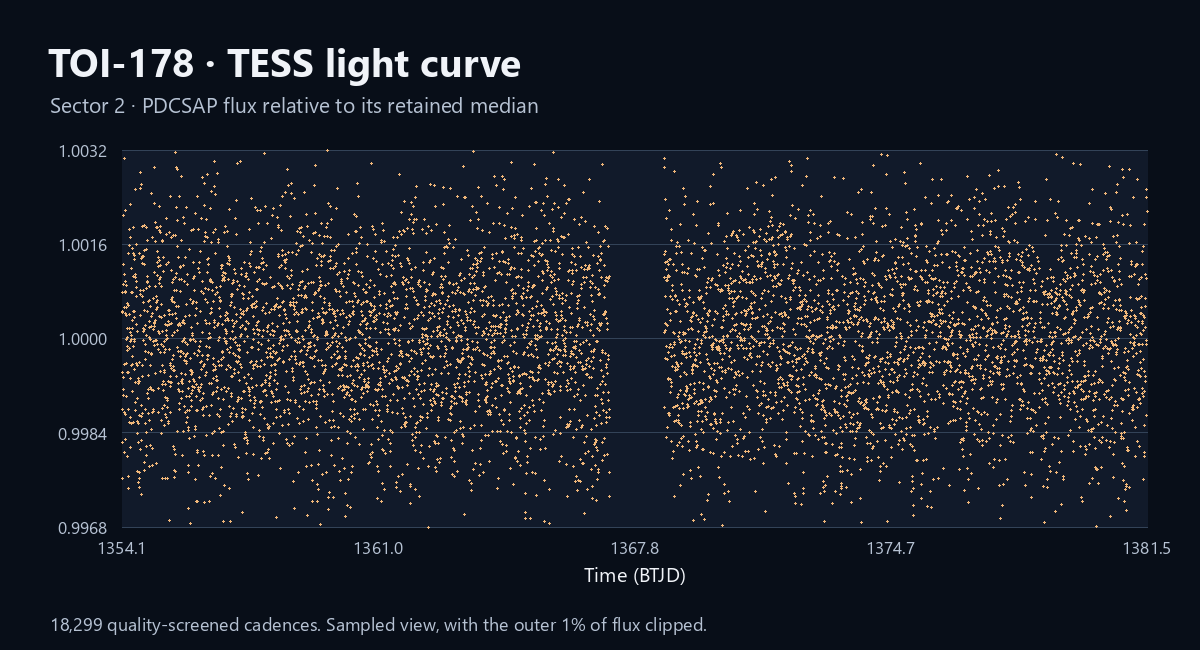
TESS Sector 2 scatter plot of normalized brightness against time, with a gap near the middle of the sector.
Exoplanet Atlas plot based on TESS Sector 2 SPOC photometry.

Sources

System cover illustration from the supplied Exoplanet Atlas dossier.