
Spacelia

371.2 light-years away

TOI-201

A short-period super-Earth, a warm Jupiter and a much more massive outer companion orbit a roughly 6,400 K star.

Start the fly-through

Scroll to fly. Drag the scene to change your view.

Host star

TOI-201

The planets in this viewer orbit this star. Its estimated temperature guides the model’s color.

Temperature
6,423 K
Radius
1.31 R☉

TIC 350618622 · Stellar surface detail is illustrative.

Planet

TOI-201 d

This is planet d of TOI-201. The model uses the published orbital period and radius.

Period
5.8489 days
Radius
1.39 R⊕
Mass estimate
5.8 M⊕
Orbit
0.0698 AU

Surface and atmospheric appearance are illustrative.

Planet

TOI-201 b

This is planet b of TOI-201. The model uses the published orbital period and radius.

Period
52.9786 days
Radius
11.4 R⊕
Mass estimate
164 M⊕
Orbit
0.303 AU

Surface and atmospheric appearance are illustrative.

Planet

TOI-201 c

This is planet c of TOI-201. The model uses the published orbital period and radius.

Period
2,890 days
Radius
10.4 R⊕
Mass estimate
4,990 M⊕
Orbit
4.37 AU

Surface and atmospheric appearance are illustrative.

Three worlds on changing orbits

Published evidence

TESS and ground photometry, Doppler velocities, and Hipparcos–Gaia astrometry support the architecture. The paper’s photodynamical solution gives 5.849, 52.979 and 2,890 days in orbital order. The outer companion has eccentricity 0.651 ± 0.006 in that solution; the astrometry-plus-RV solution gives 0.610 with broader uncertainty.

How to read the 3D model

Published periods and available eccentricities drive the orbits. Missing eccentricities are modeled as circular. Starting phases, viewing orientation, compressed distances, and surface appearances are illustrative. The atlas lists these open questions: Formation history, visible atmospheric colors, cloud patterns and any undiscovered companions.

Planet measurements

These values use the Exoplanet Atlas’s selected published solution. A dash means the value is absent from that solution.

PlanetPeriod (days)Orbit (AU)EccentricityRadius (R⊕)Mass (M⊕)
TOI-201 d 5.84890.06980.3 1.395.8
TOI-201 b 52.97860.3030.275 11.4164
TOI-201 c 2,8904.370.651 10.44,990

TESS observations

The authors identify a partial outer-companion transit in Sector 64 and a PDCSAP slope absent from SAP/QLP. A dip in that sector alone cannot establish the ingress or period. Their orbital model combines multiple data types.

Explore the MAST TESS archive
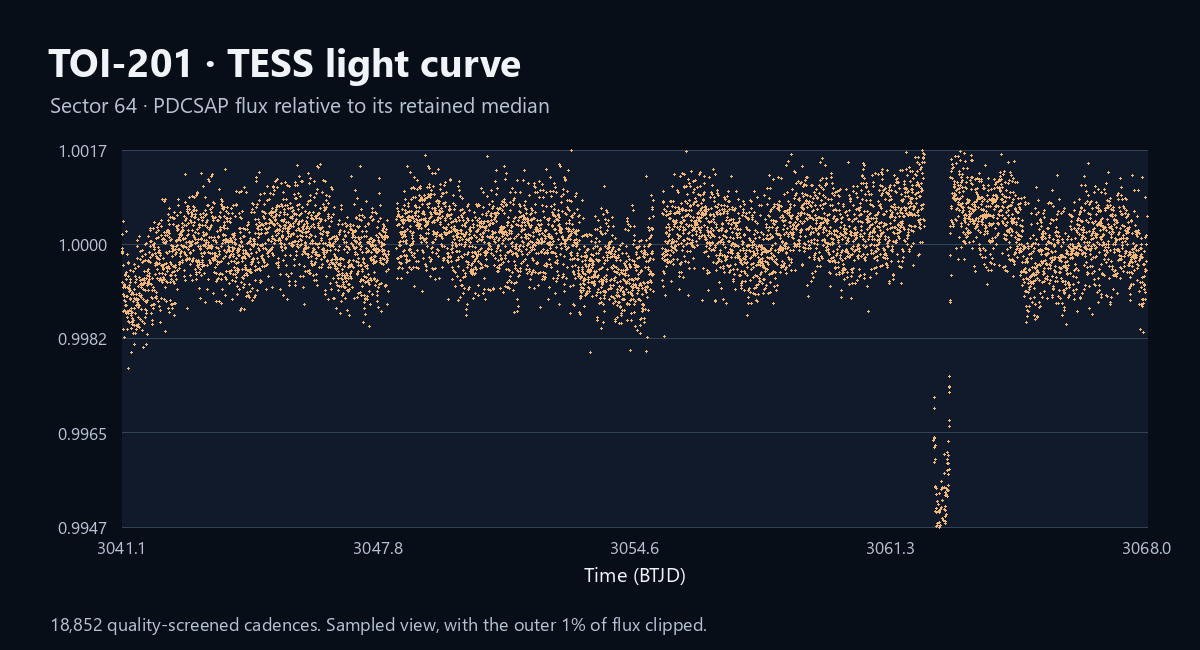
TESS light-curve plot for TOI-201.
Exoplanet Atlas plot of TESS Sector 64 photometry.

Sources

System cover illustration and observation plot from the Exoplanet Atlas.