
Two sizes across the radius valley
Published evidence
TESS, ground photometry and high-resolution imaging support the two-planet interpretation. The periods give an outer-to-inner ratio of about 2.048. That proximity alone does not establish dynamical resonance.
How to read the 3D model
Published periods and available eccentricities drive the orbits. Missing eccentricities are modeled as circular. Starting phases, viewing orientation, compressed distances, and surface appearances are illustrative. The atlas lists these open questions: Dynamical masses, bulk compositions, atmospheric properties, and whether the pair is dynamically locked.
Planet measurements
These values use the Exoplanet Atlas’s selected published solution. A dash means the value is absent from that solution.
| Planet | Period (days) | Orbit (AU) | Eccentricity | Radius (R⊕) | Mass (M⊕) |
|---|---|---|---|---|---|
| TOI-2096 b | 3.1191 | 0.025 | 0.15 | 1.243 | — |
| TOI-2096 c | 6.3878 | 0.04 | 0.1 | 1.914 | — |
TESS observations
The NASA composite includes numeric mass estimates, while the selected discovery solutions contain no measured masses. The primary physical evidence for the illustration is therefore the stellar temperature and the transit geometry and radii.
Explore the MAST TESS archive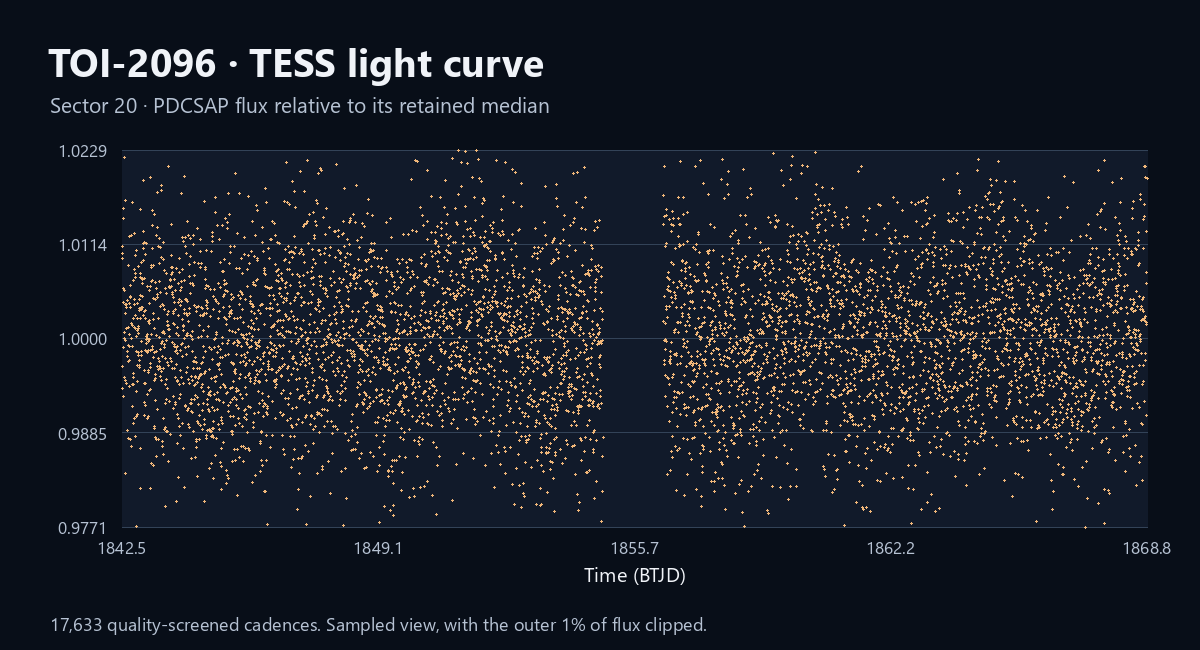
Sources
System cover illustration and observation plot from the Exoplanet Atlas.