
Spacelia

124.2 light-years away

TOI-237

The inner planet c and outer planet b transit the same cool dwarf every 1.74 and 5.44 days.

Start the fly-through

Scroll to fly. Drag the scene to change your view.

Host star

TOI-237

The planets in this viewer orbit this star. Its estimated temperature guides the model’s color.

Temperature
3,212 K
Radius
0.211 R☉

TIC 305048087 · Stellar surface detail is illustrative.

Planet

TOI-237 c

This is planet c of TOI-237. The model uses the published orbital period and radius.

Period
1.7449 days
Radius
1.206 R⊕
Mass estimate
—
Orbit
0.016 AU

Surface and atmospheric appearance are illustrative.

Planet

TOI-237 b

This is planet b of TOI-237. The model uses the published orbital period and radius.

Period
5.4361 days
Radius
1.44 R⊕
Mass estimate
—
Orbit
0.0341 AU

Surface and atmospheric appearance are illustrative.

Two small worlds with a near 3:1 period ratio

Published evidence

The follow-up study recovered both signals in TESS photometry and independently validated the inner planet using ground data.

How to read the 3D model

Published periods and available eccentricities drive the orbits. Missing eccentricities are modeled as circular. Starting phases, viewing orientation, compressed distances, and surface appearances are illustrative. The atlas lists these open questions: Atmospheric properties and whether the pair is dynamically resonant.

Planet measurements

These values use the Exoplanet Atlas’s selected published solution. A dash means the value is absent from that solution.

PlanetPeriod (days)Orbit (AU)EccentricityRadius (R⊕)Mass (M⊕)
TOI-237 c 1.74490.016— 1.206—
TOI-237 b 5.43610.03410 1.44—

TESS observations

The period ratio is close to 3:1. That numerical ratio alone cannot establish a dynamical resonance.

Explore the MAST TESS archive
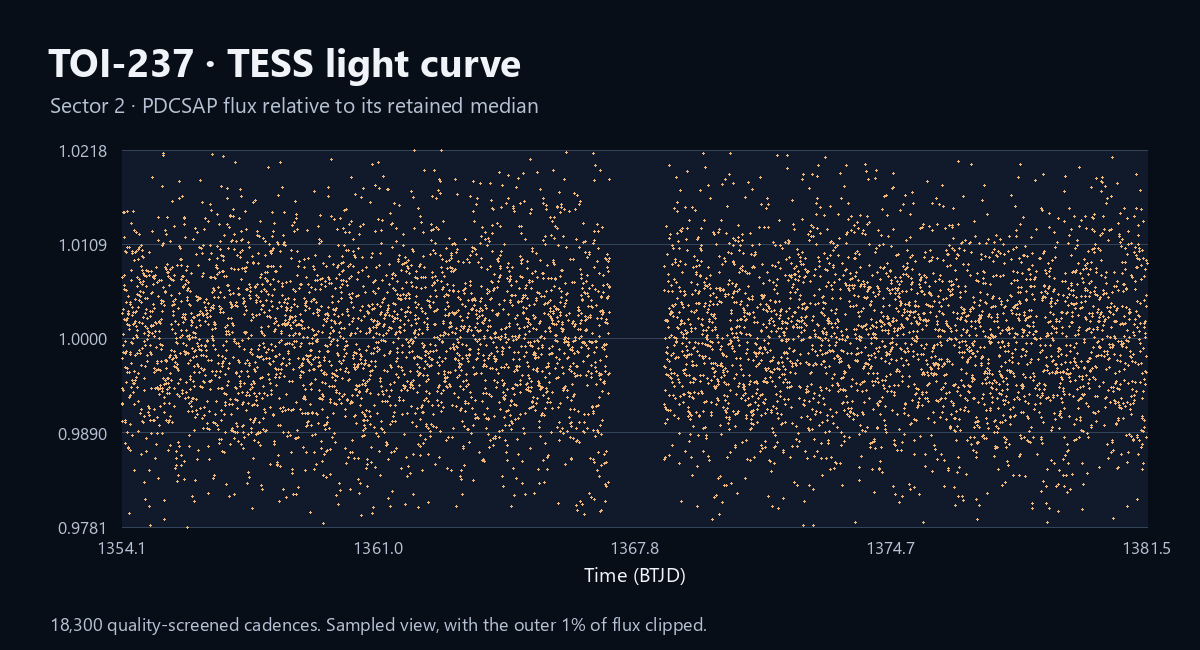
TESS light-curve plot for TOI-237.
Exoplanet Atlas plot of TESS Sector 2 photometry.

Sources

System cover illustration and observation plot from the Exoplanet Atlas.