
A compact trio and an outer giant
Published evidence
TESS photometry and HARPS-N velocities jointly constrain the inner trio. The outer companion e has a published period near 762 days, eccentricity near 0.26 and a minimum mass near 692 Earth masses.
How to read the 3D model
Published periods and available eccentricities drive the orbits. Missing eccentricities are modeled as circular. Starting phases, viewing orientation, compressed distances, and surface appearances are illustrative. The atlas lists these open questions: Actual radius and mass of the outer companion, orbital inclination, and the planets’ atmospheric appearance.
Planet measurements
These values use the Exoplanet Atlas’s selected published solution. A dash means the value is absent from that solution.
| Planet | Period (days) | Orbit (AU) | Eccentricity | Radius (R⊕) | Mass (M⊕) |
|---|---|---|---|---|---|
| TOI-4010 b | 1.3483 | 0.0229 | 0.03 | 3.02 | 11 |
| TOI-4010 c | 5.4147 | 0.058 | 0.03 | 5.93 | 20.31 |
| TOI-4010 d | 14.7089 | 0.113 | 0.07 | 6.18 | 38.15 |
| TOI-4010 e | 762 | 1.57 | 0.26 | — | 692 (minimum) |
TESS observations
The NASA composite supplies a radius estimate for e, but the selected radial-velocity paper contains no measured radius for it. The selected evidence table preserves the missing radius and labels the reported minimum mass.
Explore the MAST TESS archive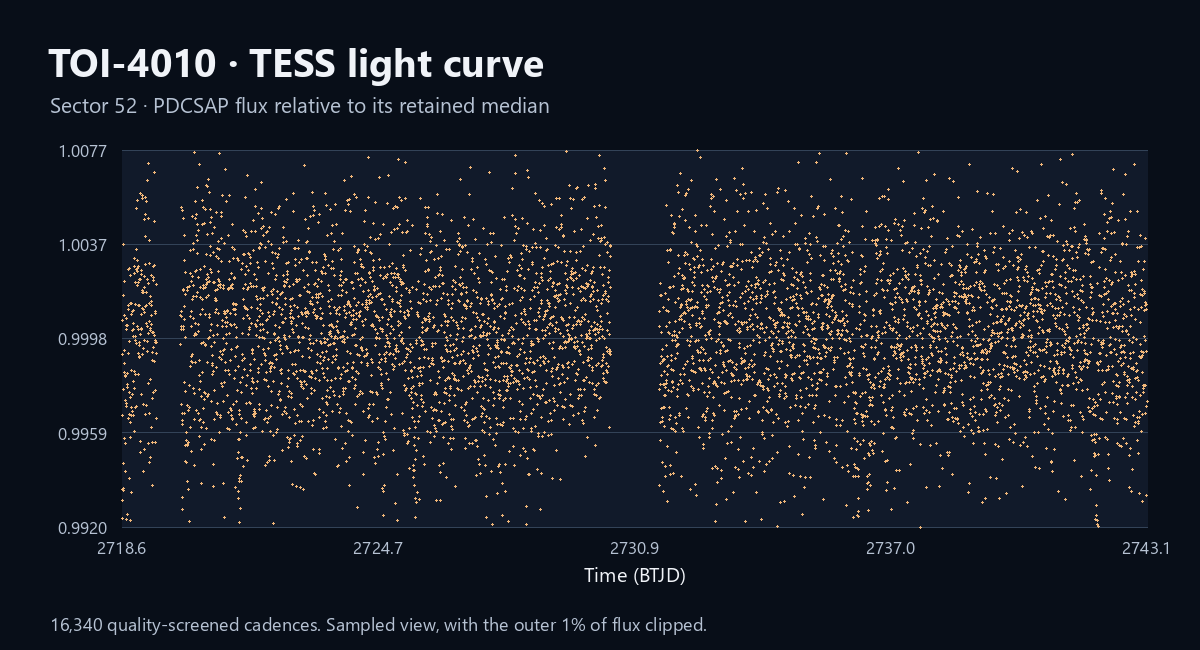
Sources
System cover illustration and observation plot from the Exoplanet Atlas.