
Two planets around one star in a triple
Published evidence
Ground photometry validates the inner transit; ESPRESSO and NIRPS work constrains the masses. The joint analysis reports about 1.55 and 3.33 Earth masses for c and b. The other two M dwarfs are stellar companions on vastly wider scales than the planetary orbits.
How to read the 3D model
Published periods and available eccentricities drive the orbits. Missing eccentricities are modeled as circular. Starting phases, viewing orientation, compressed distances, and surface appearances are illustrative. The atlas lists these open questions: Surface and visible atmospheric properties. Interior fits for b allow volatile-rich envelopes but supply no image of oceans, weather or color.
Planet measurements
These values use the Exoplanet Atlas’s selected published solution. A dash means the value is absent from that solution.
| Planet | Period (days) | Orbit (AU) | Eccentricity | Radius (R⊕) | Mass (M⊕) |
|---|---|---|---|---|---|
| TOI-4336 A c | 7.5873 | 0.0509 | 0 | 1.251 | 1.55 |
| TOI-4336 A b | 16.3364 | 0.0849 | 0 | 2.137 | 3.33 |
TESS observations
The initial transit-validation paper gives 1.17 ± 0.06 Earth radii for c. The joint photometric/RV analysis gives 1.25 ± 0.07. Their one-sigma intervals overlap. The selected illustration uses the joint solution for both planets.
Explore the MAST TESS archive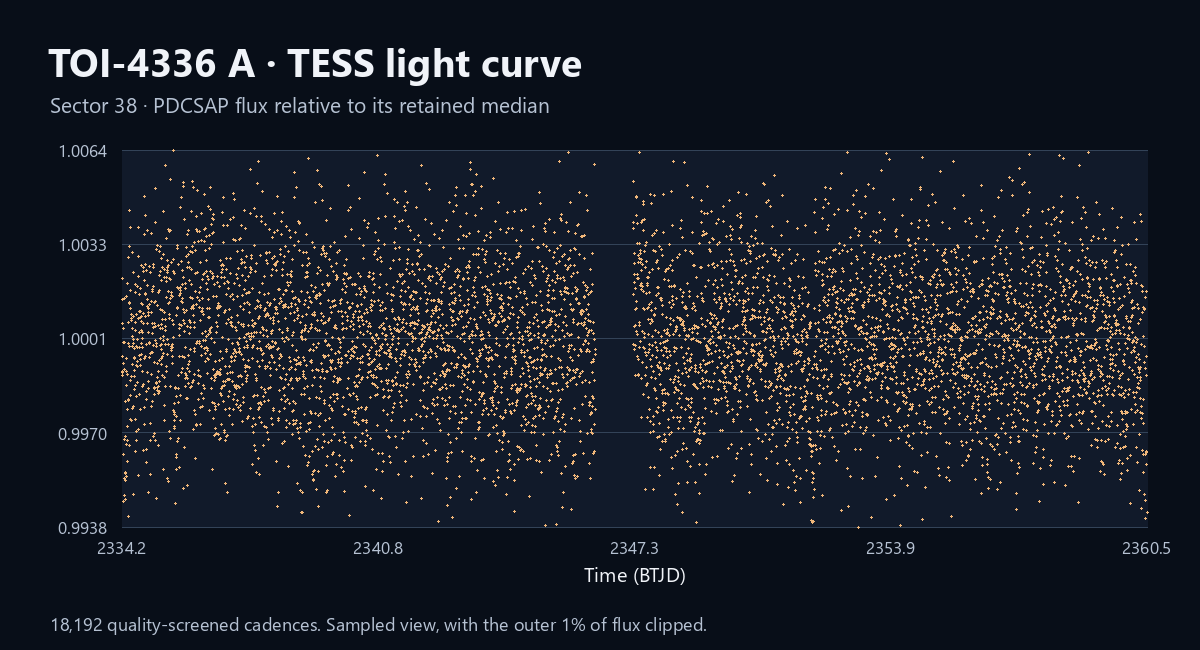
Sources
System cover illustration and observation plot from the Exoplanet Atlas.