
A giant planet comes into transit
Published evidence
The discovery combined TESS transit timing and FEROS velocities. The newer photodynamical analysis adds transits of d following nodal precession and finds periods near 41.3 and 82.8 days. The two giant radii are close to one Jupiter radius.
How to read the 3D model
Published periods and available eccentricities drive the orbits. Missing eccentricities are modeled as circular. Starting phases, viewing orientation, compressed distances, and surface appearances are illustrative. The atlas lists these open questions: The atmosphere and surface appearance of all three bodies. The unusual photodynamical mass for b is model dependent and does not set its illustrated radius.
Planet measurements
These values use the Exoplanet Atlas’s selected published solution. A dash means the value is absent from that solution.
| Planet | Period (days) | Orbit (AU) | Eccentricity | Radius (R⊕) | Mass (M⊕) |
|---|---|---|---|---|---|
| TOI-4504 b | 2.4262 | 0.0338 | 0.84 | 2.65 | 140 |
| TOI-4504 d | 41.2872 | 0.2219 | 0.293 | 11.26 | 643 |
| TOI-4504 c | 82.8191 | 0.3593 | 0.0499 | 11.17 | 821 |
TESS observations
The discovery’s non-transiting classification for d described the earlier geometry. The newer study changes that classification and revises some fitted masses. Sector 28 is an early light-curve sample, not evidence by itself of the later transition.
Explore the MAST TESS archive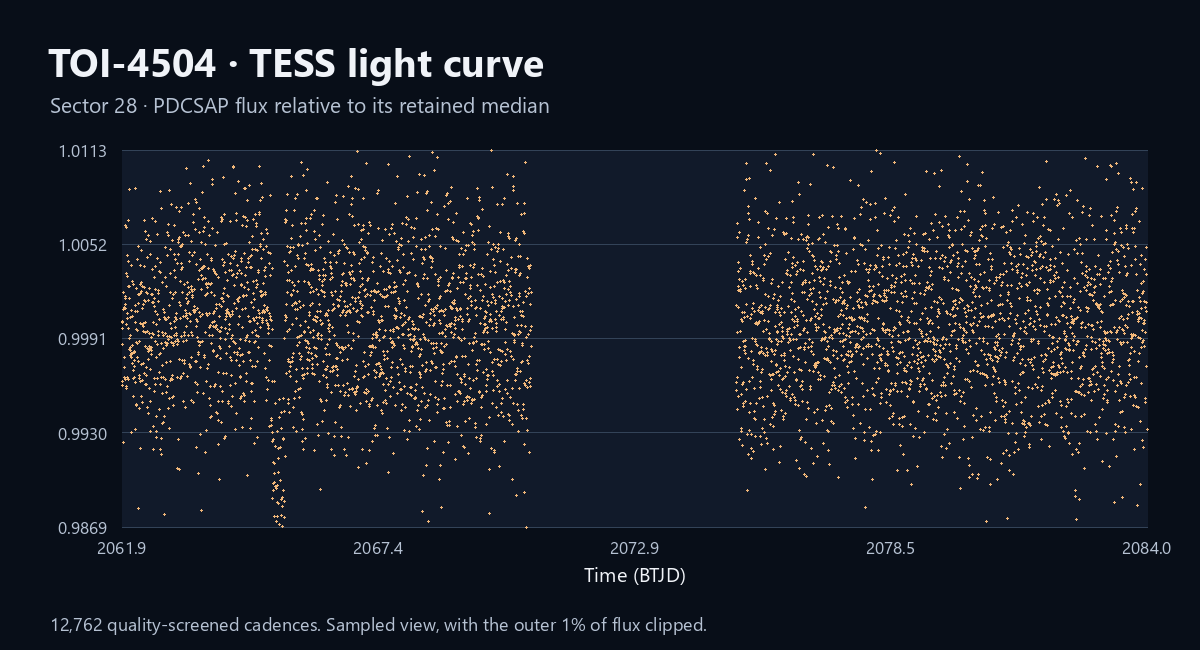
Sources
System cover illustration and observation plot from the Exoplanet Atlas.