
A temperate orbit around a red dwarf
Published evidence
TESS detection was followed by ground photometry, high-resolution imaging and statistical validation.
How to read the 3D model
Published periods and available eccentricities drive the orbits. Missing eccentricities are modeled as circular. Starting phases, viewing orientation, compressed distances, and surface appearances are illustrative. The atlas lists these open questions: Atmospheric composition, surface conditions, and the status of the second signal.
Planet measurements
These values use the Exoplanet Atlas’s selected published solution. A dash means the value is absent from that solution.
| Planet | Period (days) | Orbit (AU) | Eccentricity | Radius (R⊕) | Mass (M⊕) |
|---|---|---|---|---|---|
| TOI-715 b | 19.288 | 0.083 | — | 1.55 | — |
TESS observations
The discovery paper also discusses a second transit candidate. The confirmed membership for this dossier contains b only.
Explore the MAST TESS archive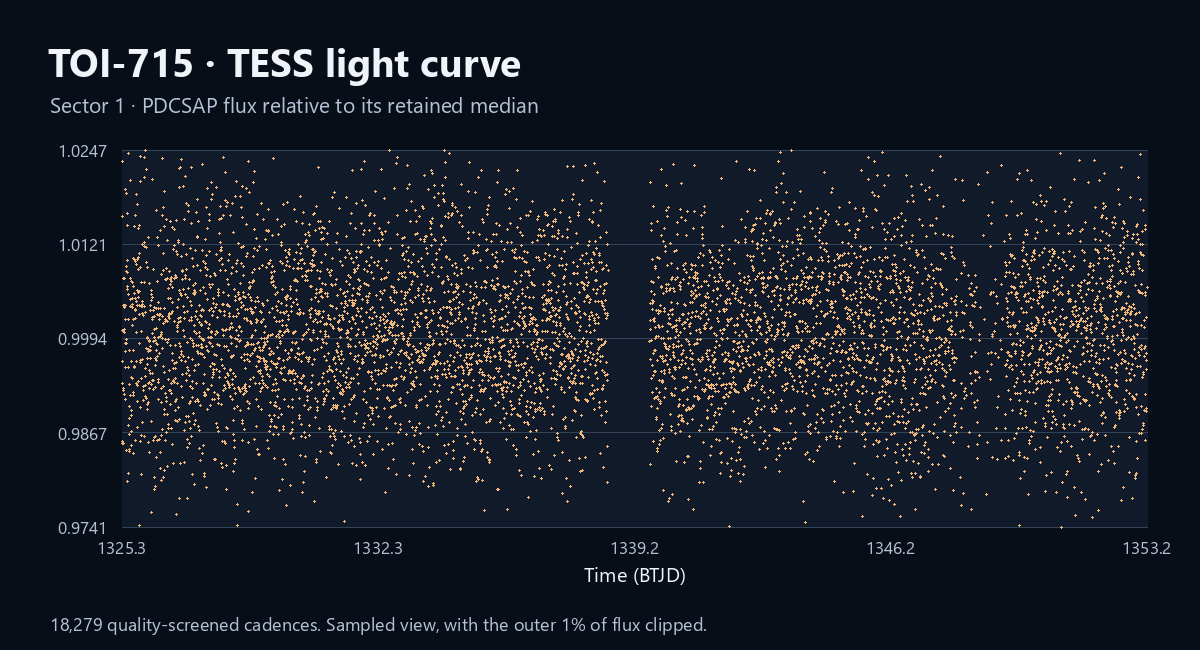
Sources
System cover illustration and observation plot from the Exoplanet Atlas.